

Maintenance motor sled assembly design for submersible dry pit solids-handling pumps.
By Martin Hawrysko
As a full-service system engineering specialist that emphasizes customization, existing and prospective clientele often turn to Metropolitan Industries for unique project proposals requiring added ingenuity not met from a “one size fits all” approach. Solving individual job site challenges with tailor-made solutions is just another day for Metropolitan Industries’ in-house engineering and fabrication personnel.
In April 2021, Emmons Metro, our northeastern U.S. branch, was brought in by the City of Albany, New York to coordinate upgrading the Woodville dry well lift station with submersible dry pit solids-handling sewage pumps. Trent Emmons, the sales manager of Emmons Metro, was initially asked to investigate the state of the existing dry well sewage pumps. At that point, there was no reason to anticipate anything out of the ordinary, let alone the idea of facilitating a custom maintenance sled assembly.
Years of routine service, excess wear and tear, plus additional stress from repeat flooding of the dry well meant servicing the existing pumps and motors with replacement parts became an unlikely stretch. “The casings for all three pumps were extremely worn out, while one of the motors was next to shot,” said Trent. “The lone pump responsible for handling fluid from its own side of the wet well was limping along and identified as needing priority attention.” Added concern for one of the alternating pumps made resolving the first pump all the more urgent.
Though replacement parts were explored, lead times going on nine months were of no help. Trent concluded a full-on replacement of the pumps and motors would best satisfy the urgent timeline of the first pump while bringing the added benefits that come with an equipment upgrade. The city agreed with the assessment and began preparation for a phased station upgrade.
The decision to convert to submersible dry pit solids-handling sewage pumps eliminated the complications from unintentional flooding. “Given that air cooled motors can be significantly damaged by flooding of the dry pit area, submersible-rated motors designed specifically for use in open air environments have become a proven go-to for dry pits throughout the country,” said Mike Tierney, Metropolitan Industries sales representative. “Enhanced equipment design allows the submersible motor to operate reliably in open air and stay protected when submerged in a flood situation.”
With the city in favor of eliminating potential electrical complications and necessary motor-repairing, resulting from a flooded dry pit, Trent selected three submersible-rated dry pit pumps manufactured by Homa Pump Technology. Rated for handling 4-inch solids with an 850 gallon-per-minute discharge, the 56 horsepower Homa pumps offered an immediate upgrade from the existing 3-inch solids-handling pumps, which needed regular service attention from repeated binding.
From the initial inspection of the job site to selecting upgraded pumps, the seemingly routine project was poised to proceed without expectation of anything out of the ordinary arising – even with an urgent timeline included in the equation – that was until the City of Albany came forward with a distinct idea.
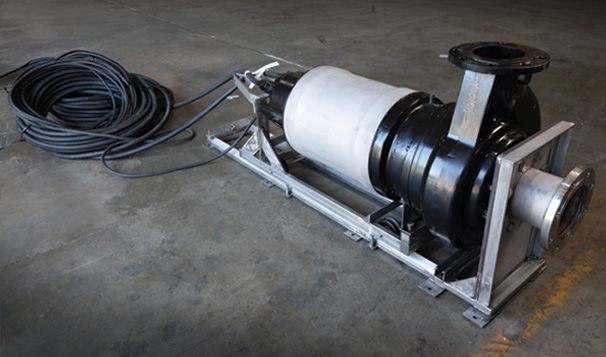
Motor sled welded to stationary base, ahead of shipping to the Woodville dry well station.
From the initial inspection of the job site to selecting upgraded pumps, the seemingly routine project was poised to proceed without expectation of anything out of the ordinary arising – even with an urgent timeline included in the equation – that was until the City of Albany came forward with a distinct idea.
Accessing each of the pumps, weighing upwards of 1500 pounds each, would have required significant labor and time. The city was interested in having an assembly added that would make the pumps easily accessible when inspecting or servicing. “I put on my thinking cap and went to work,” Trent said. “After brainstorming, I recalled seeing an installation photo of a previous pump installation with a motor sled, somewhere in Germany.”
Following multiple Google searches, Trent found the photo he had seen previously and discovered that the pump was manufactured by Homa. Trent reached out to his U.S. Homa representative to learn more about the configuration and to inquire about the possibility of implementing something similar for the Woodville dry well station.
The sled is welded to a stationary base mounted to the floor, equipped with precision guides that enables the horizontally mounted pump rotating assembly to easily slide along a wheeled track. The pump volute casing can remain connected to the station piping. The sled allows removal of the pump from the volute by simply removing six bolts. The pump slides along the track without overhead rigging, allowing operators to efficiently inspect and service with ease. The concept was devised for easy retrofit with existing dry pit pumps or when replacing.
At the time, Homa’s U.S. operation was not yet ready to provide fabrication for a motor frame that accommodates the size of the dry well pumps going to the Woodville dry well station. As a nod to the excellent relationship with Emmons Metro, Homa was willing to share renderings of the sled assembly. Trent reached out to the Metropolitan Industries team in Romeoville, Ill. with the idea of completing the fabrication in-house.
The provided drawings from Homa were carefully reviewed by essential Metropolitan Industries staff that included Paul Larson, chief engineer; Mark Homerding, fabrication department manager; Frank Ungaro, senior draftsman; and John Kochan Sr., founder. “They gave us a solid reference for how we would like to possibly assemble in-house,” said Larson.
“Upon review, we identified a few modifications we thought would enhance movement of the track wheels.” With Metropolitan Industries on board and confident with the sled fabrication, a project proposal was submitted to the City of Albany. Pleased that the motor sled assembly would satisfy service accessibility preferences, the city greenlit the proposed fabrication and began preparation to replace the existing pumps. Successfully completed in three separate phases, the first Homa pump was installed in August 2021, while the second and third pumps were installed subsequently in 2022 and 2023.
“The individual pump, sled, and rollers were assembled in 2D, then modeled in 3D with SolidWorks” said Ungaro, who completed the renderings. “Once the arrangement of the drawing is complete, it’s reviewed by engineering and fabrication. Then, necessary tweaks are implemented until we have a workable design ready for fabrication.”
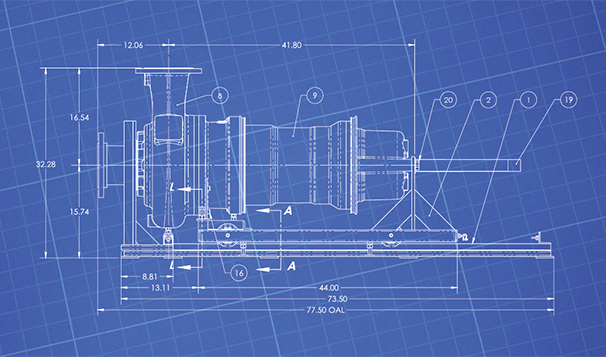
CAD drawing of custom motor sled assembly, designed and fabricated by Metropolitan Industries.
“The fab team took it from paper to real life,” said Homerding, who oversaw the fabrication of the sled and base. “Our team has decades of experience and knowledge. Tapping into each of them really pays dividends, especially with a new-to-us project. Once we get a conversation going, they have different thoughts feeding off each other, and come up with a better result at the end.”
The assembly was configured with adjusting screws on both the base and the unit itself to assist with base adjustments. Also added were jacking screws to match the pump’s level with the flange, allowing for easy sliding. An added recommendation from Kochan Sr. was to use V-groove rollers as opposed to flat, with the thought that the inverted angle would better assist movement while maintaining alignment.
Completion of the first sled took five working days over two weeks, from welding to assembly. The project was primarily TIG (tungsten inert gas) welded to accommodate the thinner tubing of the sled’s base. “As expected, we had to work out some kinks as we were building the first sled,” Homerding said. “We completed the second sled the following year in much less time.”
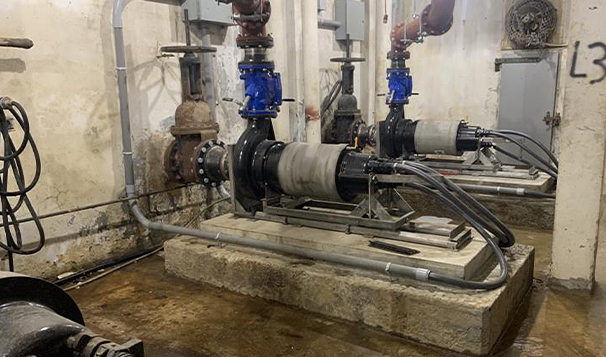
Installation of second and third dry pit pumps with respective motor sled configurations.
Throughout assembly, department assessments from engineering, sales, and service ensured the completed sled met expectations, conceptually from an engineering standpoint and operationally from a field perspective. Both sleds were successfully shipped from the Metropolitan Industries 100,000-square foot facility to the Woodville job site ahead of their respectively scheduled installations.
“In the nearly three years after the first installation, and approaching one year from the final, there hasn’t been a single bind-up issue with the pumps,” Trent said. They’ve been running flawlessly, a real testament to the design of those pumps, hydraulically speaking.”
“The successful back-to-back sled assembly and installation has positioned Metropolitan Industries and Emmons Metro to offer this proven engineered service to any municipality in need of a low-maintenance option for easing complications from dry well flooding,” said John Kochan Jr., Metropolitan Industries president.
The unique project challenge for the Woodville dry well station is a crowning example of our continued dedication to testing our abilities and becoming better – to the benefit of our clientele and industry partners. While most pumping equipment suppliers are programmed to say no to such opportunities, Metropolitan Industries and Emmons Metro are naturally inclined to saying yes.